studies in digital cultures
Digital humanities provide an opportunity to rethink how we build and transmit knowledge. One of the distinguishing features of digital humanities is the two-way relationship between the humanities and technology: the field uses technology for research in the humanities while subjecting technology to humanist questioning. As a result, researchers and students in the field are exploring the great questions of human culture through the creative and critical use of IT tools to collect, extract, organize, visualize, and disseminate information.
At the University of Ottawa, students explore and learn about digital humanities in an undergraduate program now named Digital Cultures.
Minor in Digital Cultures
In September 2016, the Faculty of Arts launched a Minor in Digital Cultures (formerly named Digital Humanities). This Minor covers all areas of the arts and humanities and allows for projects such as large-scale extraction of historical census data, research in computer linguistics, computer-assisted language learning and mapping of sound and image patterns in contemporary videos or theater performances. Since its inception in Fall 2016, the minor has offered students core competences in GIS mapping, digitization, XML, XSLT, Python, API calls, online publishing, database design, data visualization and archival research. The Digital Cultures undergraduate minor complements the core competencies that students gain in Humanities, Languages and Literatures, and Fine Arts: critical thinking, writing, research, creation. Students in the minor come from a range of home departments, including English, Communication, Psychology, and Computer Science.
The minor builds on student’s major, and consists of a series of electives and three core courses offered in French and English.
- Arts and Digital Cultures (DCN1100) – Students learn to think about projects as conceptual units, engage with foundational theoretical approaches and projects in the field, and create their own macro- and micro-analysis of Humanities content using secondary sources, data sets, text encoding, and visualization. Recent projects include the 2020 digital edition of Jane Eyre.
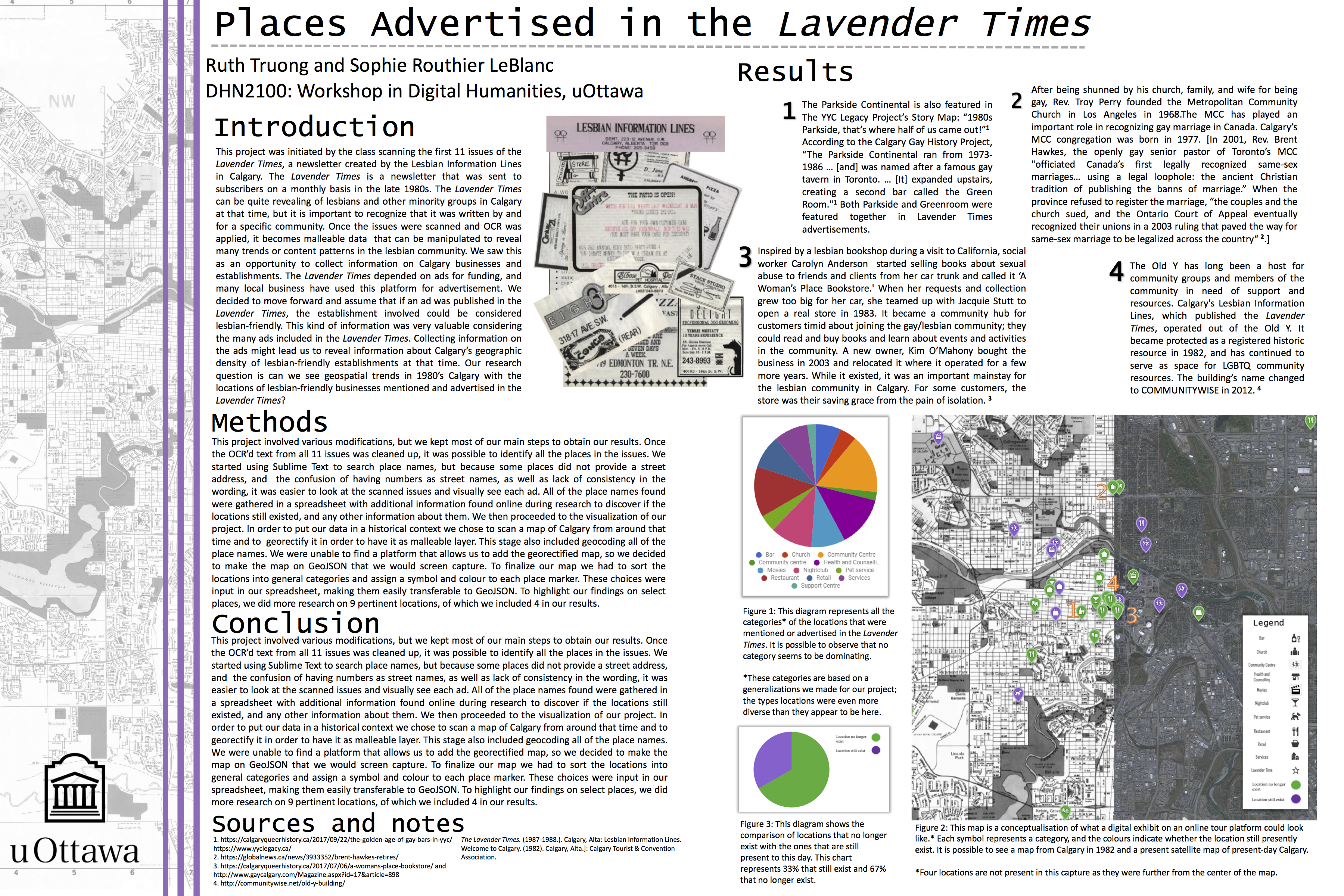
- Workshop in Digital Cultures (DCN2100) – Students have learned to digitize and analyse primary source material using GIS, command line text analysis, and visualization, and have received training in project management and social innovation. In 2018 students showcased their visualizations and analysis at the Digital History Open House. In 2019 we partnered with the Association of Canadian Archivists, to give the students a chance to learn to work with clients and to use their skills to frame and solve others’ problems.
The students also take electives from across the Faculty of Arts, ranging from English and Geography to Music and Translation Studies. That said, the listed Digital Cultures Minor electives are not the only courses in which students can hone their technical skills and habits of mind. There are many digitally inflected courses offered across the Faculty that have a digital creation component; English, Geography, Music, Visual Art, History, Theatre, and Communication are particularly strong in this area.
For more information visit the Digital Cultures program on the University of Ottawa website.
Questions? Email the program Coordinator, Dr. Jada Watson at dhnarts@uOttawa.ca
 Le Carrefour des SHN / DH-Hub