
DH Toolbox: Winter 2026
The Digital Humanities Data Lab and the Pol Comm Tech Lab are happy to invite you to this year’s DH Toolbox Workshops.
The 2026 DH Toolbox is a practical, arts-focused workshop series offering introductory, hands-on training in core digital humanities skills. The series features seven workshops, from February to April, led by researchers and practitioners from the University of Ottawa and partner institutions. The workshops draw diverse participants from across campus and cultural heritage organizations, including Libraries and Archives Canada and Ingenium, with sessions offered in a mix of both English and French.
These workshops offer participants a unique opportunity to learn core skills surrounding digital humanities, learn from their peers, and grow their network.
February 4, 2026 – Asher Lacho – HTML, CSS, and Web Accessibility – PRZ302 1:00 – 2:20 PM (English/French)
In this hands-on workshop, you’ll learn the fundamentals of HTML, CSS, and web accessibility by building a webpage step by step. We’ll start with HTML structure and tags, then style your page with CSS, and finish by applying accessibility best practices so your sites work for all users, including those using screen readers or keyboard navigation. Through 20 interactive lessons with real-time code verification and live preview, you’ll gain practical skills that you can immediately apply to create your own accessible web pages. Please bring a laptop with a modern web browser (Chrome, Firefox, Safari, or Edge) to the workshop. No coding experience or additional software installation is required—everything runs in your browser!
Asher Lacho (they/them, il/lui) is a Queer, non-binary interdisciplinary researcher and PhD student in Communications and Media Studies at the University of Ottawa. Their work bridges Media Studies, Anthropology, and Digital Humanities to explore how people create a sense of belonging, sustain consent, and build ethical relations through digital technology. With a background in North American Anthropology and Digital Humanities, Lacho approaches communication as a field where language, media, and technology continually shape one another. Their research focuses on how communities use media and digital platforms to negotiate visibility, safety, and intimacy in the face of stigma and censorship. Lacho’s doctoral project examines how Queer kink communities build intimacy, identity, and consent across online and in-person spaces. Before their PhD, Lacho completed an MA in Interdisciplinary Graduate Studies at the University of British Columbia, where they co-developed an Augmented Reality storytelling app in Secwepemctsín, an endangered language. This project combined community-based research with immersive media to support Indigenous language revitalization. It was recognized when Lacho was named UBC Okanagan’s Researcher of the Year (Master’s) and received the SSHRC Canada Graduate Scholarship to Honour Nelson Mandela. Alongside academia, Lacho has experience in software engineering. They are a co-inventor on four U.S. patents in conversational AI and digital commerce, and have led projects in augmented reality, data streaming, and user experience design. These experiences inform their approach to studying media systems critically, from platform governance to the politics of moderation, attention, and visibility.
February 11, 2026 – Constance Crompton – Intro to the Command Line – SMD328 1:00 – 2:20 PM (English)
Are you curious about what the command line is and why you need it? In this hands-on workshop you will learn the basics of controlling your computer from the command line in order to navigate your system and create and manipulate files. We’ll conclude with a few exercises to show how you can use a few command line prompts to replace what could well be hours of work clicking around on a Graphic User Interface or working with software like Word or Google Docs. Please install VS Code on your computer and bring it with you to the workshop (if you have trouble installing VS Code, feel free to arrive at 12:30pm for installation help).
Constance Crompton is a white, queer, able-bodied settler and Canada Research Chair in Digital Humanities. They direct the University of Ottawa’s Labo de données en sciences humaines/The Humanities Data Lab, and are a member of several research project teams: Lesbian and Gay Liberation in Canada, Linked Infrastructure for Networked Cultural Scholarship, the Implementing New Knowledge Environments Partnership, and the Transgender Media Portal. They live and work on unceded Algonquin land.
February 25, 2026 – Constance Crompton and Asher Lacho – Git and GitHub – PRZ302 1:00 – 2:20 PM
In this hands-on workshop, you’ll learn the basics of Git and GitHub to manage your code, track changes, and work with others. We’ll start with Git fundamentals—creating repositories, making commits, and understanding version control—then move to GitHub to push your code, create branches, and collaborate through pull requests. We’ll conclude with practical exercises showing how version control can help you recover from mistakes, experiment safely, and work with teams. Please install Git on your computer and create a free GitHub account before the workshop. This workshop assumes basic familiarity with the command line. If you’re new to the command line, we recommend taking our “Introduction to the Command Line” workshop first.
Constance Crompton is a white, queer, able-bodied settler and Canada Research Chair in Digital Humanities. They direct the University of Ottawa’s Labo de données en sciences humaines/The Humanities Data Lab, and are a member of several research project teams: Lesbian and Gay Liberation in Canada, Linked Infrastructure for Networked Cultural Scholarship, the Implementing New Knowledge Environments Partnership, and the Transgender Media Portal. They live and work on unceded Algonquin land.
Asher Lacho is a Queer, non-binary interdisciplinary researcher and PhD student in Communications and Media Studies at the University of Ottawa. Their work bridges Media Studies, Anthropology, and Digital Humanities to explore how people create a sense of belonging, sustain consent, and build ethical relations through digital technology. With a background in North American Anthropology and Digital Humanities, Lacho approaches communication as a field where language, media, and technology continually shape one another. Their research focuses on how communities use media and digital platforms to negotiate visibility, safety, and intimacy in the face of stigma and censorship. Lacho’s doctoral project examines how Queer kink communities build intimacy, identity, and consent across online and in-person spaces. Before their PhD, Lacho completed an MA in Interdisciplinary Graduate Studies at the University of British Columbia, where they co-developed an Augmented Reality storytelling app in Secwepemctsín, an endangered language. This project combined community-based research with immersive media to support Indigenous language revitalization. It was recognized when Lacho was named UBC Okanagan’s Researcher of the Year (Master’s) and received the SSHRC Canada Graduate Scholarship to Honour Nelson Mandela. Alongside academia, Lacho has experience in software engineering. They are a co-inventor on four U.S. patents in conversational AI and digital commerce, and have led projects in augmented reality, data streaming, and user experience design. These experiences inform their approach to studying media systems critically, from platform governance to the politics of moderation, attention, and visibility.
March 11, 2026 – Felicity Tayler – Data wellness: Zine-Making Workshop! – PRZ302 1:00 – 2:20 PM – (French)
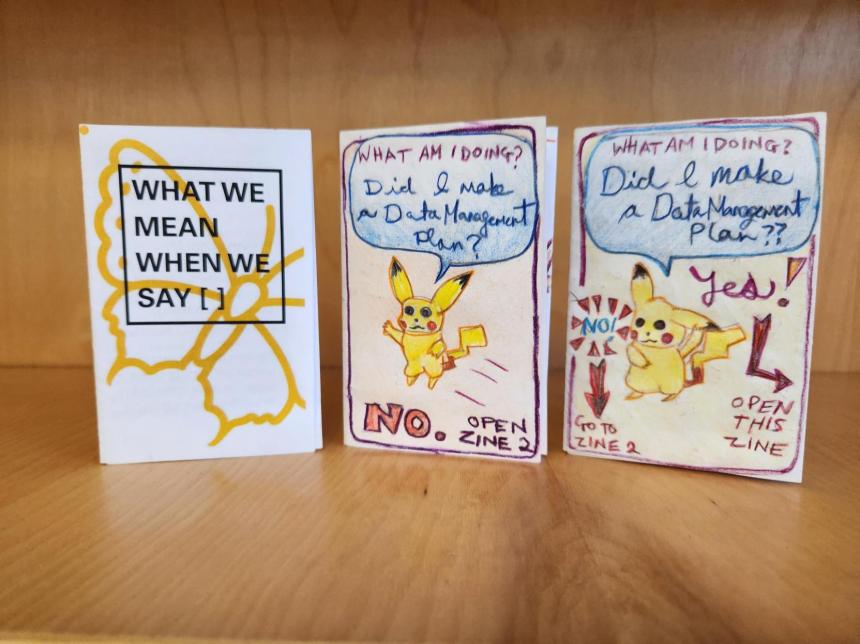
Does managing your data flow leave you feeling depleted and wracked with eye strain? Join us for a bilingual zine-making workshop where you use paper, markers, and other collage materials to apply the fundamentals of research data management in an 8-page zine format! Some materials provided, but feel free to bring your own.
Felicity Tayler is the Research Data Management Librarian at University of Ottawa Library. Her research interests include metadata modelling, data visualization, and the print culture of literary and poetic community. She is a founding member of the Leadership team of the Data Literacy Research Institute, and a Research Associate of the Humanities Data Lab. As a member of the Digital Research Alliance RDM National Training Expert Group, she was the lead author on the bilingual OER, Data Primer: Making Digital Humanities Research Data Public / Manuel d’introduction aux données : rendre publiques les données de recherche en sciences humaines numériques. Also a visual artist and curator, she has produced several exhibitions, and is working on a monograph describing oral history and computational methods for exploring co-publishing relationships in literary and artistic communities.
March 18, 2026 – Sylvie Grosjean, Janette Mujica, Mackenson Joseph – Modeling AI Recommendation Logic: The PD-TIPS.AI Project – PRZ302 1:00 – 2:20 PM – (English/French)
The PD-TIPS.AI project aims to develop an AI-powered Conversational Recommender System (CRS) to support people living with Parkinson’s disease in their self-care practices. This workshop implements a sociotechnical design approach by simulating how the AI system integrates the diverse care trajectories and needs of people living with Parkinson’s to deliver personalized care recommendations. Working in small groups, participants will simulate the AI’s reasoning to model its decision-making logic. By cross-referencing user profiles (Persona Ontology) with various categories of care advice (Care Tips), you will produce decision trees structuring the recommendation pathways as well as a prioritization matrix for interventions based on variables specific to each persona. This workshop represents a fundamental step in the co-design process: it facilitates the transformation of clinical and experiential knowledge into concrete logical rules, ensuring that the AI’s technical architecture remains intrinsically aligned with the human and social realities of its users.
Dr. Sylvie Grosjean is a full professor in the Department of Communication and the Com&Tech Innovations Lab director. Holding a Ph.D. in cognitive and social psychology, she focuses her current research on the sociotechnical design of AI-powered digital health tools. Moving beyond a focus on algorithmic performance, Dr. Grosjean investigates human-AI coupling as a situated and distributed process. Her research is grounded in qualitative and collaborative methodologies, including organizational ethnography, narrative and visual methods, and participatory design. Dr. Grosjean specializes in using videoethnography and multimodal interaction analysis to examine the complex dynamics between humans and AI systems. Dr. Grosjean is the lead researcher for the PD-TIPS.AI project, funded by the CHRI, which develops AI-powered conversational recommender systems (based on LLM) to support self-care for people living with Parkinson’s disease. Additionally, she is involved in the analysis of doctor/patient/AI system interactions – with the Virtuosis.AI project – employing multimodal interaction analysis to inform the development of advanced training modules for healthcare providers. Also, she examines the impact of AI systems on organizational communication, care coordination, and clinical decision-making within intricate healthcare environments.
Janette Mujica is a PhD student in Digital Transformation and Innovation at the University of Ottawa’s Faculty of Engineering. She holds credentials in Digital Humanities, Innovation Management, Cinema, UX Design, and Full-Stack Web Development, reflecting an interdisciplinary background spanning the humanities, design, and technology. Prior to these studies, she worked as an executive assistant in high finance and management consulting, an experience that shaped her interest in how professional practices are socially constructed through everyday interactions and material artifacts. Since September 2024, she has served as a research assistant on the PD-TIPS.AI project at the Com&Tech Innovations Lab. Her research examines how patient, clinical, and technical knowledge are negotiated in “AI” co-design, with a focus on power dynamics and the recognition of patient expertise.
Mackenson Joseph is a PhD candidate in the Department of Communication at the University of Ottawa. I hold a bachelor’s degree in social communication at the Faculty of Humanities of University of Haitian State in Haiti, and a Master of Management in Beijing Jiaotong University in China. Currently, under Dr Sylvie Grosjean, I am conducting my thesis work on immersive technology and interprofessional communication within extreme context. And, also assisting in the eCARE-PD project.
March 25, 2026 – Alan Colin-Arce – Collaboration and Open Scholarship on the Humanities and Social Sciences Commons – PRZ302 1:00 – 2:20 PM – (English)
This talk will discuss the theoretical foundations and features of the Humanities and Social Sciences (HSS) Commons, an open online space for sharing research outputs, connecting with other researchers, establishing a professional online presence, and more. The HSS Commons has the mission to connect and support the work of Humanities and Social Sciences researchers across Canada. On the HSS Commons, members can share, access, develop, re-purpose, and preserve scholarly data and resources through our repository. Members can also create a user profile, connect to their academic association, build an interest group, and share content. The development of the HSS Commons is informed by debates in the digital humanities and open scholarship, so our work is guided by the values of community governance, care and multilingualism. Therefore, the site is managed and governed by the academic community and the interface is available in five languages, including English and French. The talk will also have a practical component to illustrate how to use the HSS Commons to create an account on the site, use the repository to share research outputs, and create a group to collaborate with other researchers.
Alan Colin-Arce is a MITACS Internship Fellow in Open, Collaborative Scholarship at the University of Victoria’s Electronic Textual Culture Lab. His research focuses on the influence of language and geography in knowledge production, especially in web archives and scholarly communication. He is the research lead for the the Humanities and Social Sciences Commons and he has contributed to several multilingual digital humanities projects, including the Open Scholarship Policy Observatory, Uncomfortable Footprints, and Latin American Women’s Rights Movements: Tracing Online Presence through Language, Time and Space.
April 8, 2026 – Micki Kauffman – Archives in the Algorithmic Anthropocene – Online (Zoom) 1:00 – 2:20 PM – (English)
In her talk, “Archives in the Algorithmic Anthropocene,” Micki will facilitate a conversation regarding the potentially epoch-shifting implications of reconceptualizing archives as procedurally generated data landscapes. Exploring the potential impacts of the current day’s migration of human archival practice into an AI-mediated frame, Micki will postulate and demonstrate multidimensional information spaces that combine computational text, network and data analysis processes with environmental psychology, aesthetics and interactivity to create an interactive virtual archive. No technical skills or software are required for this talk.
Micki Kaufman earned her BA from Columbia University and her MA and MPhil from the City University of New York, where she is currently a doctoral candidate in US History. Micki is recipient of the Lisa Lena and Paul Fortier Prizes by the Association for Computers in the Humanities (ACH) and the Alliance of Digital Humanities Organizations (ADHO) for her dissertation, “‘Everything on Paper Will Be Used Against Me:’ Quantifying Kissinger,” an analysis of the US National Security Archive’s Kissinger Collection. She is also an accomplished film composer and recording engineer, for award-winning films such as “Concussion (2013)” and “Live from the Fall (1996)” by Blues Traveler.
 Le Carrefour des SHN / DH-Hub
You must be logged in to post a comment.